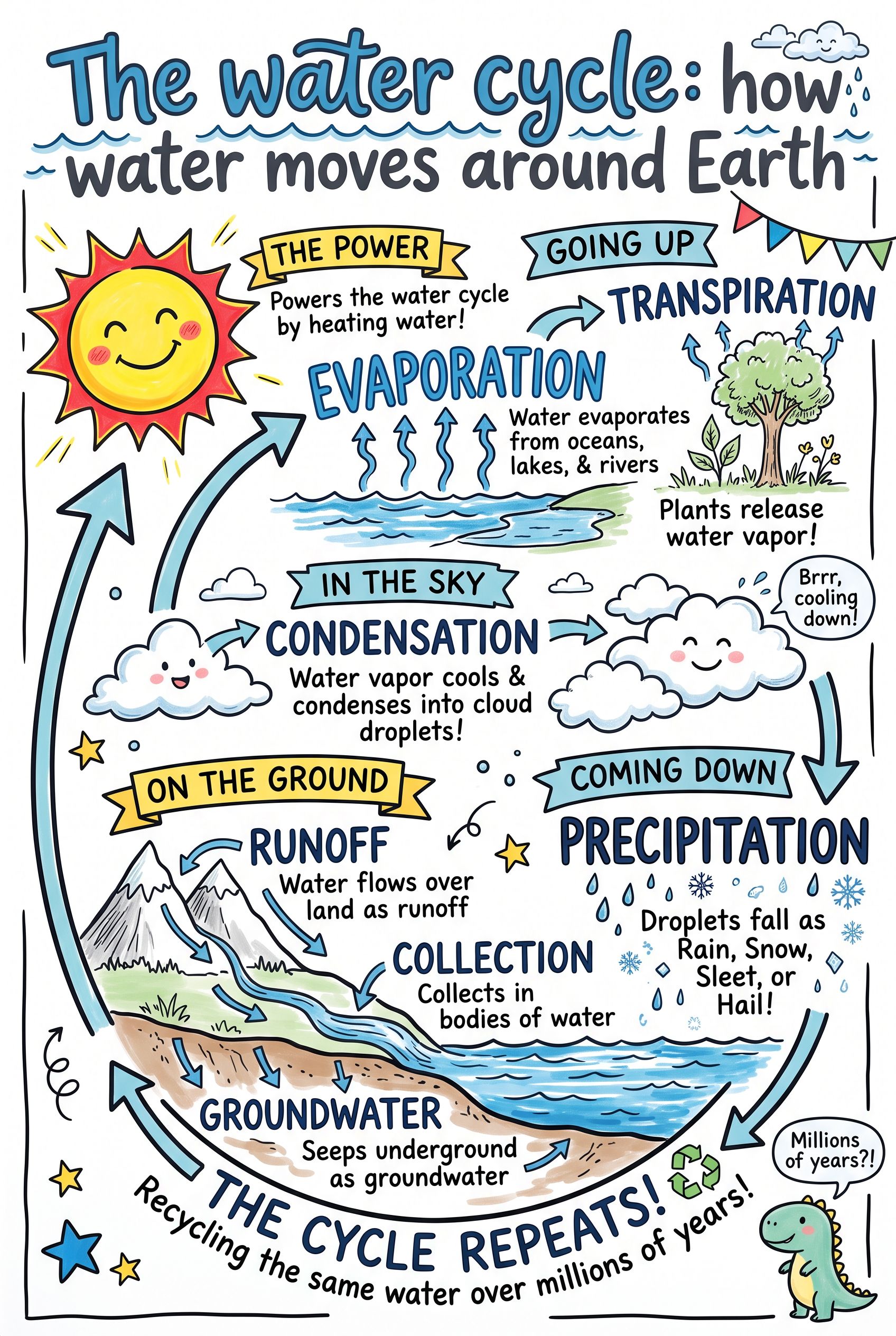
The water cycle is the way water moves around Earth. The sun heats water so it rises into the air, cools into clouds, falls back down, and collects again.
What’s on this sketchnote
The sun powers the cycle
The sun’s heat is what keeps water moving.
1. Evaporation
The sun heats water in oceans, lakes, and rivers. Liquid water turns into water vapor, an invisible gas, and rises into the air.
2. Transpiration
Plants also release water vapor from their leaves.
3. Condensation
Higher in the sky the air is cooler. Water vapor cools and turns into tiny droplets that form clouds.
4. Precipitation
When the droplets join together and get heavy, they fall as rain, snow, sleet, or hail.
5. Collection
Water gathers in oceans, lakes, and rivers. Some flows over the land as runoff. Some soaks into the ground and becomes groundwater.
Then it starts again
The water on Earth today has been moving around this cycle for millions of years.
Key vocabulary
- Evaporation: liquid water changing into water vapor.
- Condensation: water vapor changing back into liquid droplets.
- Precipitation: water falling from clouds to the ground.
- Groundwater: water stored underground in soil and rock.
Use it in class
- Act it out: students move around the room as “water drops” and name each stage they reach.
- Put a bowl of warm water under plastic wrap in the sun, and match what students see to the sketchnote.
- For a hands-on version, use the free water-cycle template.
Check for understanding
- A puddle disappears on a sunny day. Where did the water go? It evaporated into water vapor in the air, and some may have soaked into the ground.
- Are clouds made of water vapor? No. Clouds are made of tiny liquid droplets or ice crystals. Water vapor itself is invisible.