Matter is anything that has mass and takes up space. On Earth it is most often found as a solid, a liquid, or a gas. Heating or cooling matter can change it from one state to another.
What’s on this sketchnote
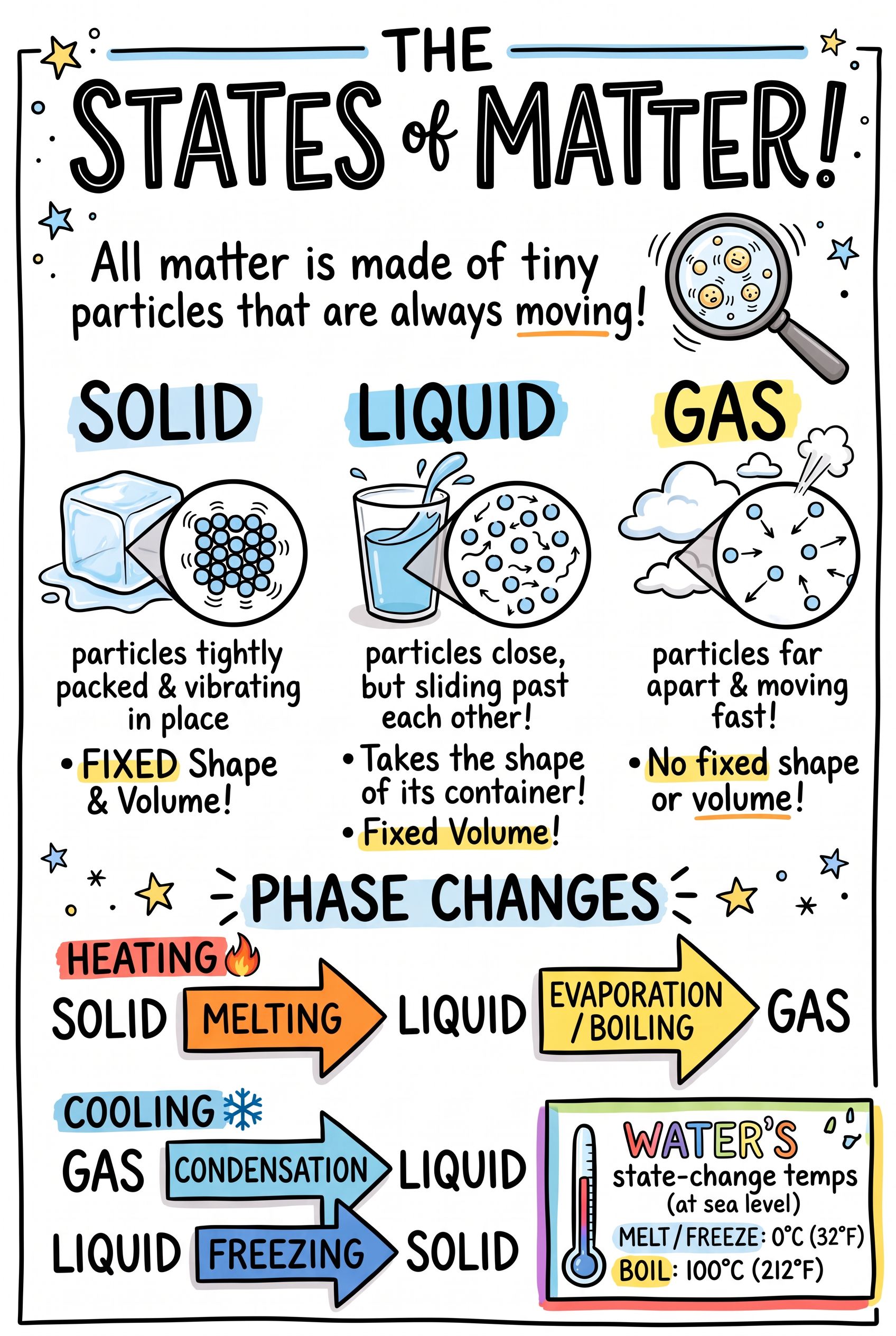
Everything is made of particles
All matter is made of tiny particles that are always moving.
Solid, for example an ice cube
- Particles are packed tightly and only vibrate in place.
- A solid keeps its own shape and volume.
Liquid, for example water in a glass
- Particles are close together but can slide past each other.
- A liquid takes the shape of its container but keeps the same volume.
Gas, for example water vapor in the air
- Particles are far apart and move quickly in all directions.
- A gas spreads out to fill any container. It has no fixed shape or volume.
Changing state
- Heating: melting turns a solid into a liquid. Evaporation or boiling turns a liquid into a gas.
- Cooling: condensation turns a gas into a liquid. Freezing turns a liquid into a solid.
- Water melts at 0°C (32°F) and boils at 100°C (212°F) at sea level.
Key vocabulary
- Particle: a tiny piece of matter, too small to see.
- Volume: how much space something takes up.
- Melting and freezing: changes between solid and liquid.
- Evaporation and condensation: changes between liquid and gas.
Use it in class
- Sort a bag of classroom objects into solids, liquids, and gases.
- Ask students to move like particles in each state: still and close, sliding, then spread out and fast.
- Melt an ice cube in a cup and point to each change on the sketchnote.
Check for understanding
- Why does juice change shape when you pour it into a different glass? It is a liquid, so its particles slide past each other and it takes the shape of its container.
- Water droplets form on the outside of a cold can. Which change of state is this? Condensation: water vapor in the air cools and turns into liquid.