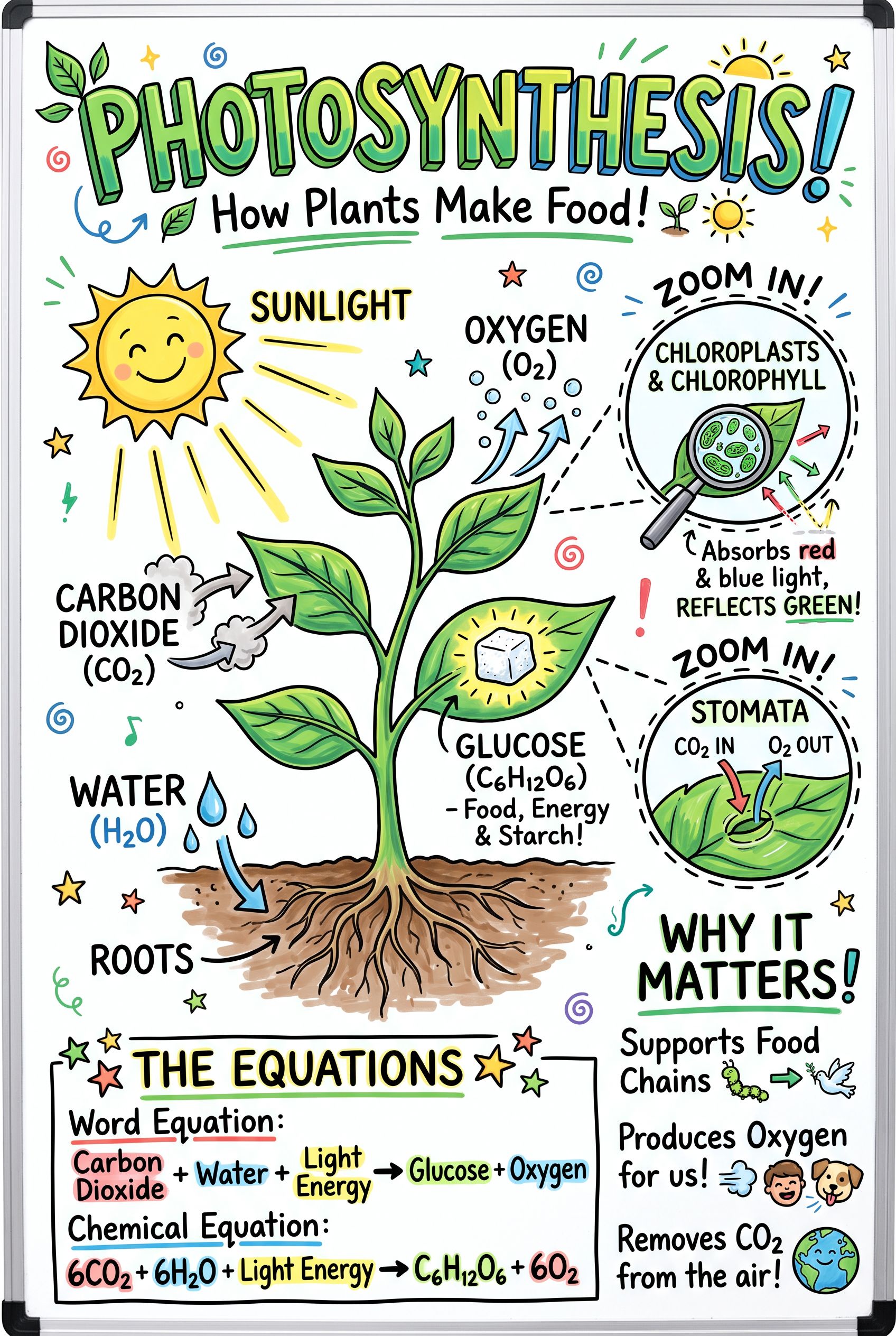
Photosynthesis is the process plants use to make their own food. A plant takes in sunlight, water, and carbon dioxide, and uses them to make glucose (a sugar) and oxygen.
What’s on this sketchnote
What goes in
- Sunlight provides the energy. It is captured by chlorophyll, the green pigment in leaves.
- Water is taken up by the roots and carried up to the leaves.
- Carbon dioxide enters the leaf from the air through tiny pores called stomata.
Where it happens
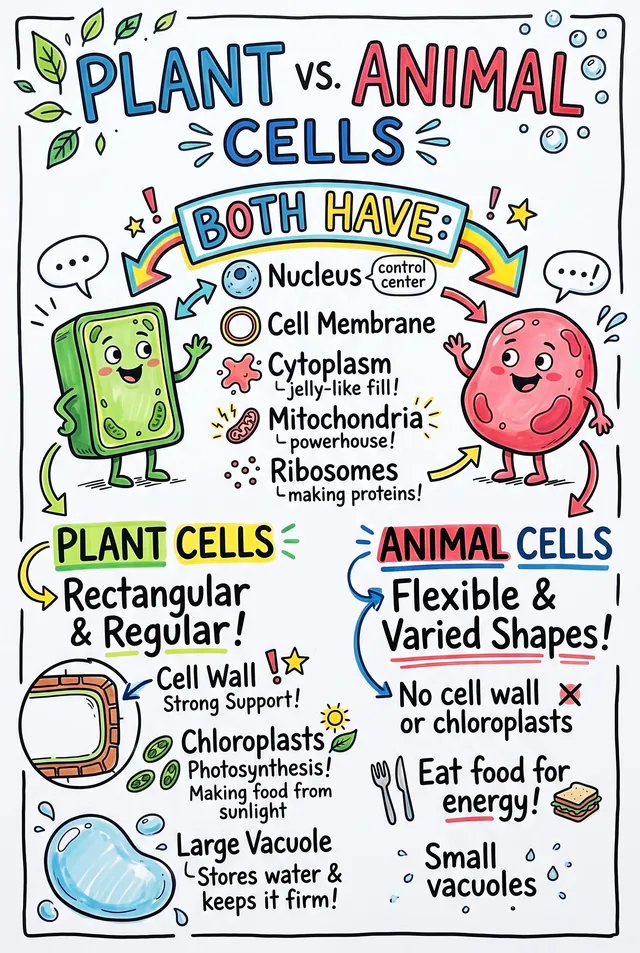
Photosynthesis takes place in chloroplasts, mostly in the cells of leaves. Chlorophyll absorbs red and blue light and reflects green light, which is why most leaves look green.
What comes out
- Glucose, which the plant uses for energy and growth or stores as starch.
- Oxygen, which is released into the air through the stomata.
The equation
- Word equation: carbon dioxide + water + light energy → glucose + oxygen
- Chemical equation: 6CO₂ + 6H₂O + light energy → C₆H₁₂O₆ + 6O₂
Why it matters
Photosynthesis is the starting point of most food chains. It adds the oxygen animals and people breathe, and it removes carbon dioxide from the air.
Key vocabulary
- Chlorophyll: the green pigment that absorbs light energy.
- Chloroplast: the part of a plant cell where photosynthesis happens.
- Stomata: small openings, mostly on the underside of leaves, that let gases in and out.
- Glucose: a simple sugar that stores energy.
Use it in class
- Show the sketchnote before a leaf or pondweed experiment and ask students to predict what the plant needs.
- Cover the outputs and ask students to fill them in from memory.
- Pair it with cellular respiration, which uses glucose and oxygen to release energy.
Check for understanding
- Where does the carbon in glucose come from? From carbon dioxide in the air, not from the soil.
- Why would a plant kept in the dark stop making glucose? Photosynthesis needs light energy, so without light it cannot happen.