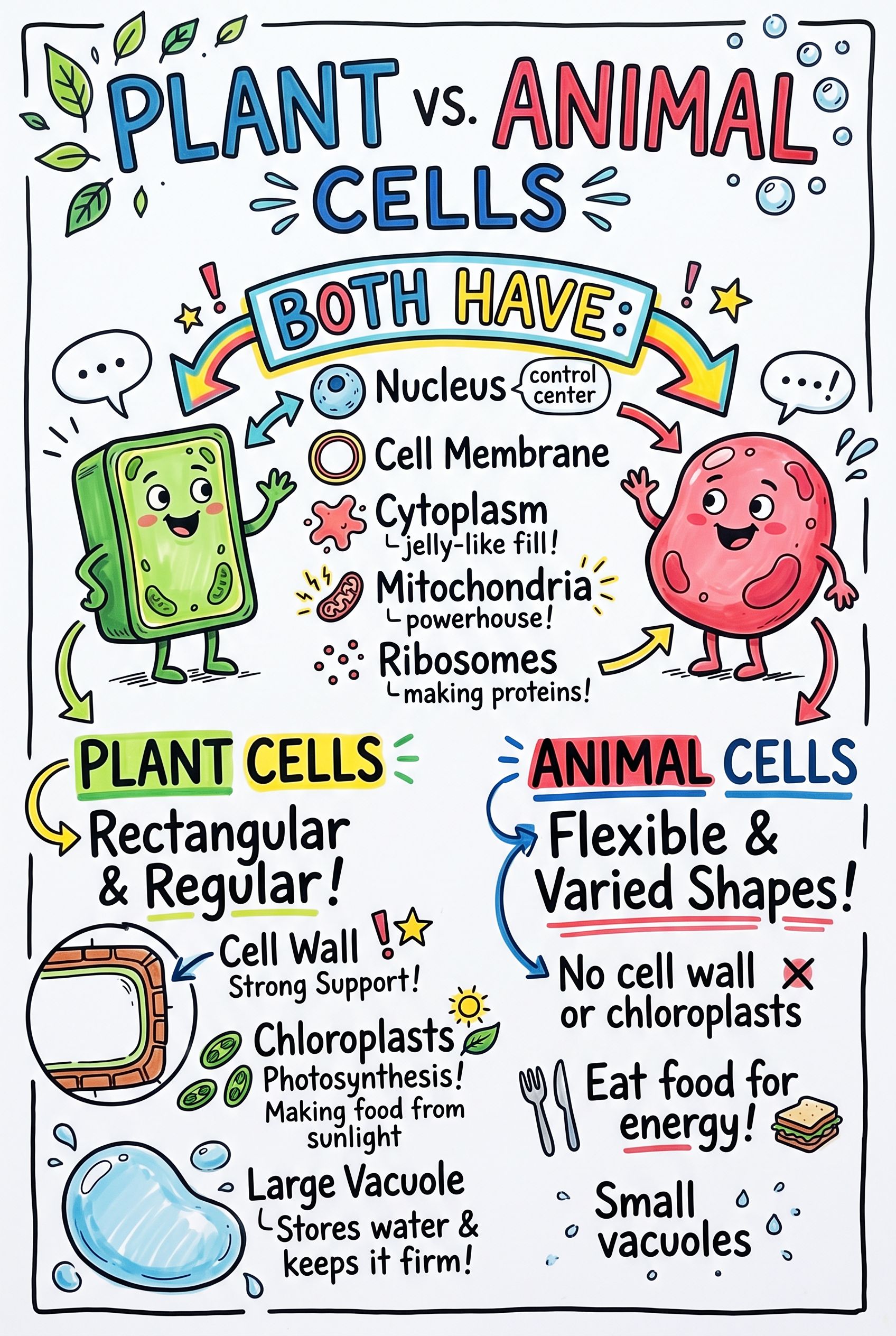
Plant and animal cells share many of the same parts. Plant cells also have a cell wall, chloroplasts, and a large central vacuole, which animal cells do not.
What’s on this sketchnote
Parts both cells have
- Cell membrane: a thin layer that controls what enters and leaves the cell.
- Nucleus: holds the cell’s DNA and controls its activities.
- Cytoplasm: the jelly-like fluid that fills the cell.
- Mitochondria: release energy from food through cellular respiration.
- Ribosomes: make proteins.
Only in plant cells
- Cell wall: a stiff outer layer made of cellulose that supports the cell.
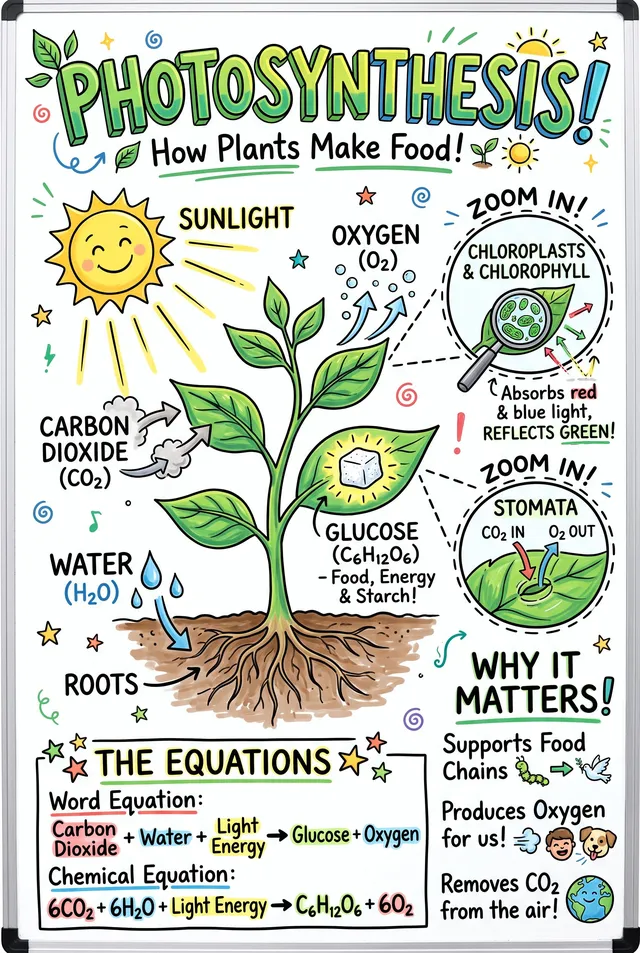
- Chloroplasts: contain chlorophyll and carry out photosynthesis.
- Large central vacuole: stores water and helps keep the plant firm.
Animal cells
- No cell wall, so they have a flexible, often rounded shape.
- No chloroplasts, so animals get their energy by eating food.
- Vacuoles are small, if present.
Shape
Plant cells are often rectangular and regular. Animal cells come in many shapes.
Key vocabulary
- Organelle: a structure inside a cell with a specific job.
- Cellulose: the tough material that makes up plant cell walls.
- Vacuole: a storage space inside a cell.
Use it in class
- Have students build a Venn diagram from the sketchnote, then compare it with a labeled diagram in their textbook.
- Look at onion skin and cheek cells under a microscope and find the parts shown here.
- Ask students to explain each plant-only part by linking it to something a plant needs.
Check for understanding
- Why do plant cells need chloroplasts, but animal cells don’t? Plants make their own food by photosynthesis. Animals get energy by eating.
- What keeps a plant cell’s shape firm? The cell wall, together with water stored in the central vacuole.