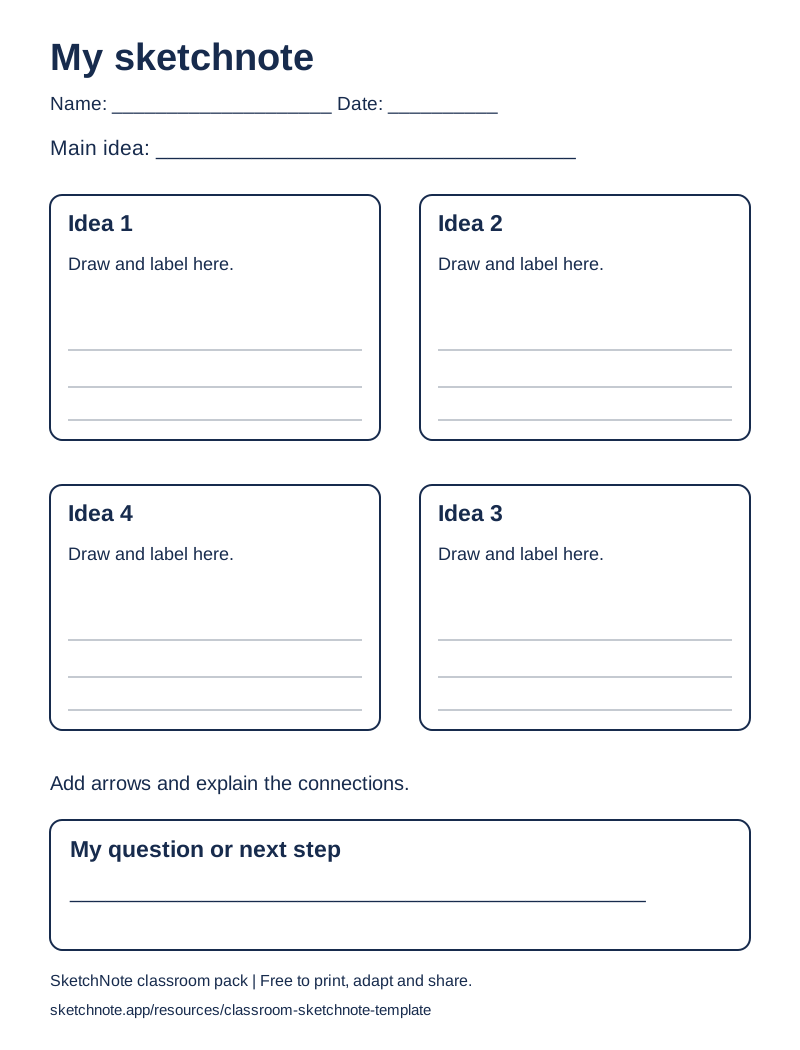
Blank sketchnote template
A topic line, four idea panels, and space for a question. Make it your own with labeled drawings and arrows.
Download blank template ↓Printable classroom pack
A free classroom sketchnote template, a worked water-cycle example, and a short teaching activity. Start with pencil and paper. No account or drawing app needed.
Free to print, adapt and share. SVG downloads. Save as PDF from the print page.
A topic line, four idea panels, and space for a question. Make it your own with labeled drawings and arrows.
Download blank template ↓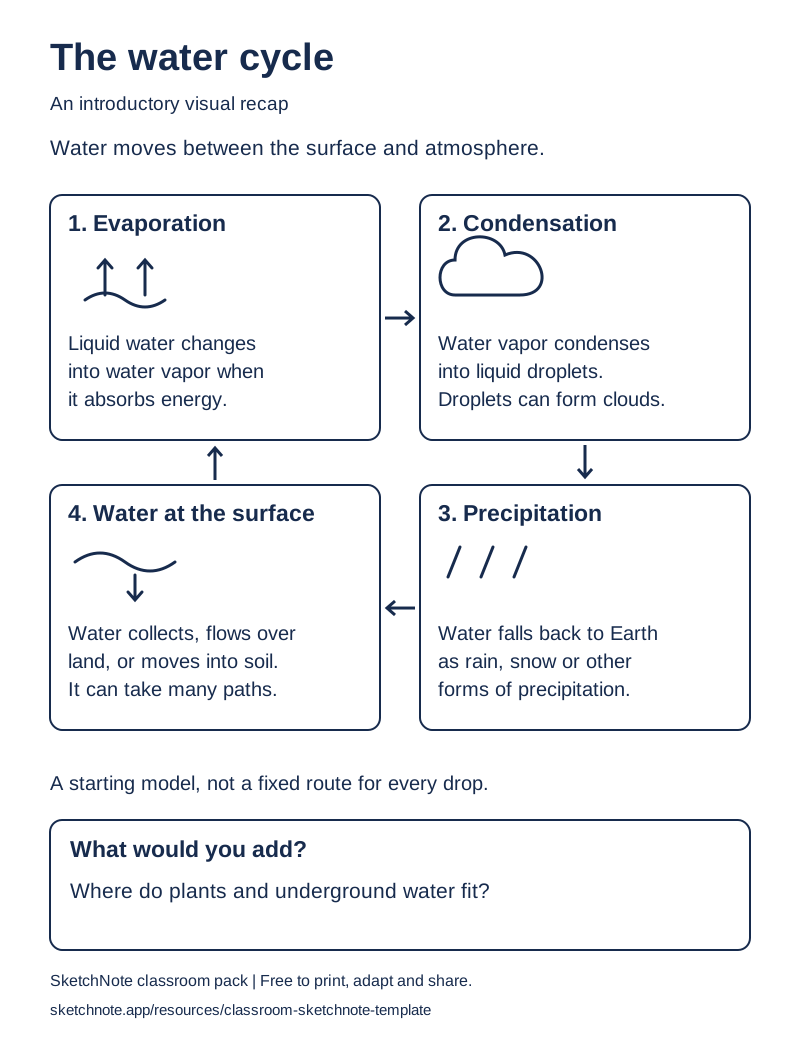
A completed science recap to discuss together. Extend it with plants, ice, or underground water.
Download worked example ↓Print in portrait orientation on A4 or Letter with “fit to page” selected. Both sheets use dark text on white paper. The print page lets you choose one sheet at a time.
Use this after teaching the topic. The timings are a suggested lesson structure, not a tested learning intervention. Adjust the language and pace for your class.
Students can write, dictate, or describe their connections aloud if drawing or handwriting is a barrier. Keep a text explanation alongside the visual. Assess the accuracy of the ideas and connections rather than artistic skill.
This is an original diagram prepared for this pack, rather than an output generated by the SketchNote app. Its explanations follow NOAA’s water-cycle education resource. NOAA does not endorse this pack.
This introductory recap leaves out other pathways and stores, including transpiration, ice and groundwater flow. Water does not follow one fixed four-step route. Ask students to add a branch for plants or underground water using the NOAA resource.
Ask: “A puddle gets smaller on a dry day. Where might the water have gone?” A useful answer mentions evaporation into water vapor, and may mention water entering the ground depending on the surface.
Then ask: “Are clouds made only of water vapor?” The answer should distinguish invisible vapor from the tiny liquid droplets or ice crystals in clouds. The example focuses on liquid droplets.
The four boxes are a starting point. Students can draw extra arrows or use the reverse of the page for a topic that needs more space. Try it for a story’s events, a historical sequence, or a process from a science lesson.
A prepared visual can introduce a topic or support discussion. Students choosing and explaining their own ideas is a different activity. This pack makes no claim that viewing an AI-generated image produces the same learning benefits as drawing or writing notes yourself.
If you use SketchNote to prepare a lesson recap, start with material you have permission to use. Check every label, arrow and factual claim against that material before sharing the result. Keep student names and private classroom information out of your source notes.
For lesson planning ideas, read how to use sketchnotes in the classroom. For a generated draft, follow the teacher’s AI sketchnote review workflow before using it as a handout.
You may print, adapt and share the two original SVG sheets for classroom or workshop use, including on a school learning platform. Attribution is welcome but optional. This permission covers these sheets, not third-party resources or other images on this site.
For a public resource list, this page is the best reference because it includes instructions and the source. There is no requirement to link back.
Need a handout with your own questions? Use the free worksheet formatter. For more practical tools, visit the classroom tools directory.