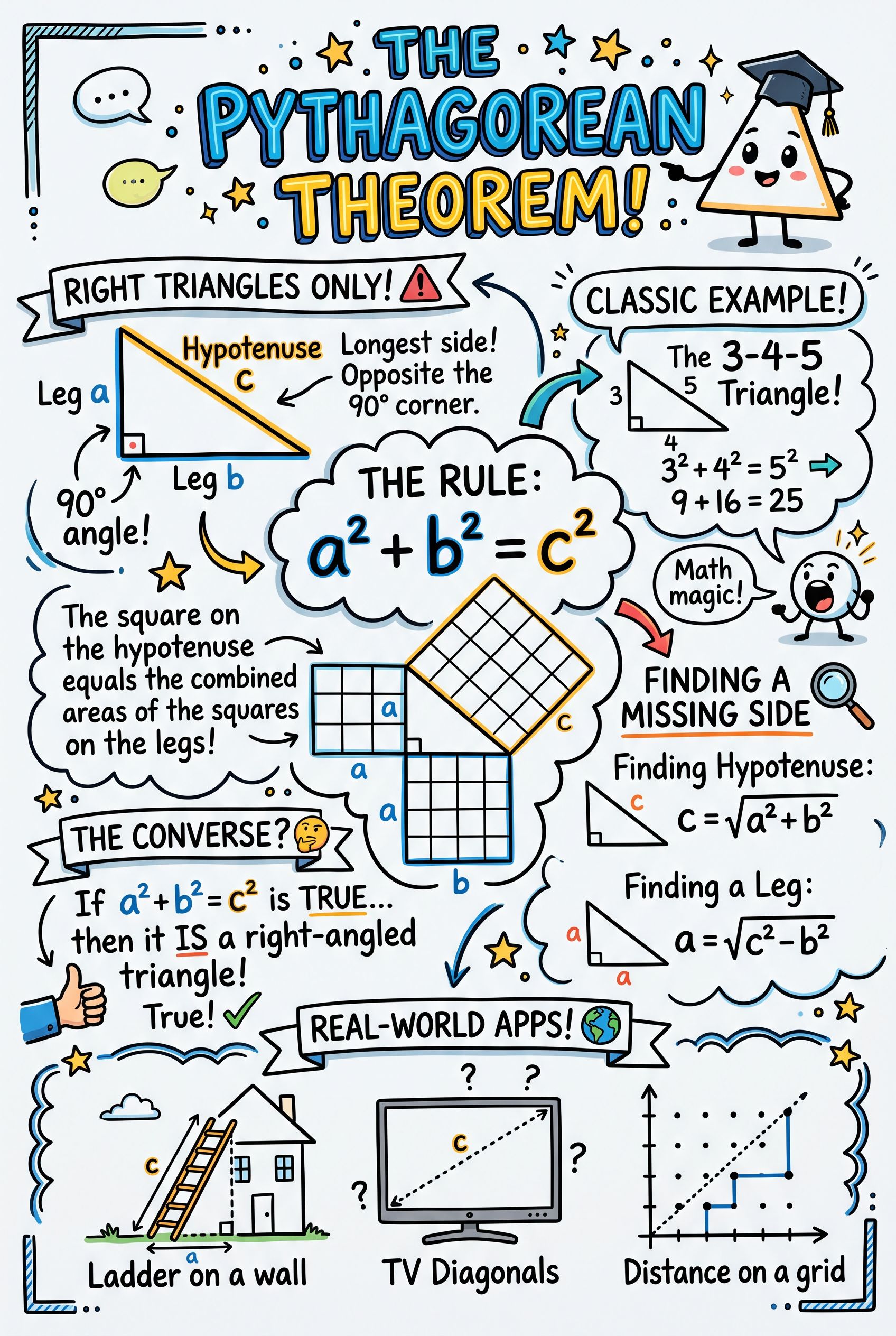
The Pythagorean theorem says that in a right triangle, the squares of the two shorter sides add up to the square of the longest side: a² + b² = c².
What’s on this sketchnote
Right triangles only
The theorem works only for triangles with a 90° angle.
Parts of a right triangle
- Legs: the two sides that form the right angle, called a and b.
- Hypotenuse: the side opposite the right angle, called c. It is always the longest side.
The rule
a² + b² = c². The square drawn on the hypotenuse has the same area as the two squares on the legs added together.
Example: a 3-4-5 triangle
3² + 4² = 9 + 16 = 25 = 5²
Finding a missing side
- Missing hypotenuse: c = √(a² + b²)
- Missing leg: a = √(c² − b²)
The converse
If a² + b² = c², then the triangle is a right triangle.
Real-world uses
- Working out how long a ladder needs to be to reach a window.
- Finding the diagonal size of a TV screen.
- Measuring the straight-line distance between two points on a coordinate grid.
Key vocabulary
- Right angle: an angle of exactly 90°.
- Hypotenuse: the longest side of a right triangle, opposite the right angle.
- Square root: the number that, multiplied by itself, gives the original number.
Use it in class
- Have students cut out squares on the sides of a 3-4-5 triangle to see the areas match.
- Give a ladder problem and ask students to point to which part of the sketchnote they used.
- Ask students to test whether 5, 12, 13 and 6, 7, 9 form right triangles using the converse.
Check for understanding
- A right triangle has legs of 6 and 8. How long is the hypotenuse? √(36 + 64) = √100 = 10.
- Can the hypotenuse ever be shorter than a leg? No. It is always the longest side of a right triangle.