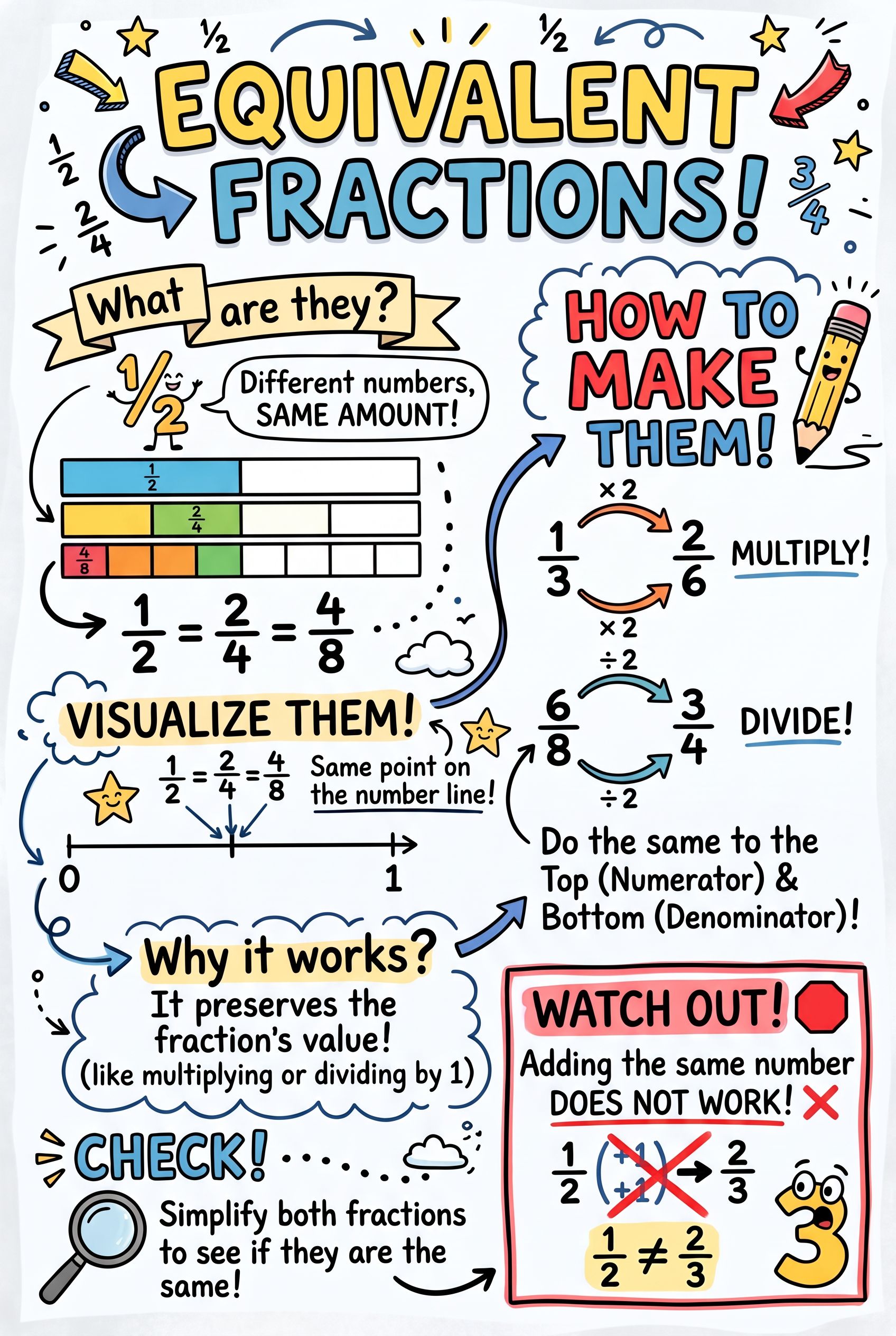
Equivalent fractions are different fractions that name the same amount. For example, 1/2, 2/4, and 4/8 all show half of a whole.
What’s on this sketchnote
Different names, same amount
1/2 = 2/4 = 4/8
See it with models
- Fraction bars: one half of a bar covers the same length as two fourths or four eighths.
- Number line: 1/2, 2/4, and 4/8 all land on the same point.
How to make an equivalent fraction
- Multiply the numerator and the denominator by the same number: 1/3 × 2/2 = 2/6.
- Divide the numerator and the denominator by the same number: 6/8 ÷ 2/2 = 3/4.
Why it works
Multiplying by 2/2 is the same as multiplying by 1, so the value does not change.
Watch out
Adding the same number to the top and bottom does not work. 1/2 is not equal to 2/3.
Check your answer
Simplify both fractions. If they match, they are equivalent.
Key vocabulary
- Numerator: the top number, showing how many parts you have.
- Denominator: the bottom number, showing how many equal parts make the whole.
- Simplify: divide the top and bottom by the same number to get the smallest equivalent fraction.
Use it in class
- Fold paper strips into halves, fourths, and eighths and line them up to match the sketchnote.
- Give pairs a fraction and ask them to find three equivalent fractions, then check on a number line.
- Use the “watch out” box to start a discussion about common mistakes.
Check for understanding
- Is 3/4 equivalent to 6/8? Yes. Multiply 3/4 by 2/2 to get 6/8.
- A student says 2/3 = 3/4 because they added 1 to the top and bottom. Are they right? No. Equivalent fractions come from multiplying or dividing the top and bottom by the same number, not adding.