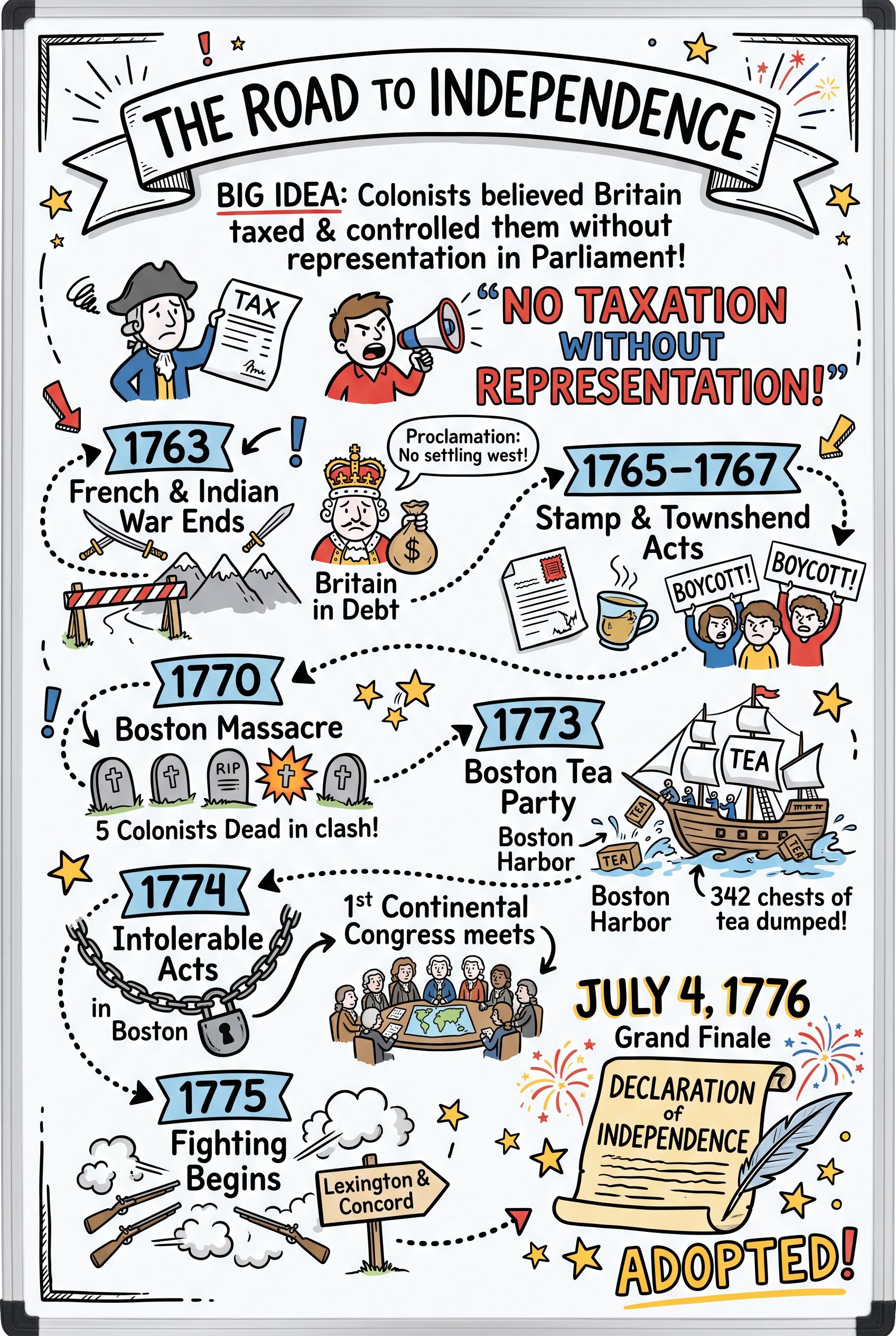
The American Revolution grew out of a series of events between 1763 and 1776. Many colonists believed Britain was taxing and controlling them without giving them a voice in Parliament, summed up in the slogan “no taxation without representation.”
What’s on this sketchnote
The big idea
Colonists felt they were being taxed and governed without representation.
Timeline
- 1763: The French and Indian War ends, leaving Britain with large war debts. The Proclamation of 1763 bans settlement west of the Appalachian Mountains.
- 1765: The Stamp Act taxes printed paper such as newspapers and legal documents. Colonists protest and boycott British goods.
- 1767: The Townshend Acts tax imported goods such as glass, paper, and tea.
- 1770: The Boston Massacre. British soldiers fire into a crowd and kill five colonists.
- 1773: The Boston Tea Party. Colonists dump 342 chests of British tea into Boston Harbor to protest the Tea Act.
- 1774: The Intolerable Acts close Boston Harbor and limit self-government in Massachusetts. The First Continental Congress meets.
- April 1775: The battles of Lexington and Concord, the first fighting of the war.
- July 4, 1776: The Declaration of Independence is adopted.
Key vocabulary
- Representation: having people who speak and vote for you in government.
- Boycott: refusing to buy goods as a form of protest.
- Parliament: Britain’s lawmaking body.
Use it in class
- Ask students to rank the events by how much they pushed the colonies toward war, and defend their top choice.
- Assign each group one event and ask them to explain it from a colonist’s and a British official’s point of view.
- Have students add a primary source quote to each point on the timeline.
Check for understanding
- Why did Britain start taxing the colonies after 1763? To help pay its debts from the French and Indian War.
- What did “no taxation without representation” mean? Colonists objected to paying taxes set by a Parliament where they had no elected members.