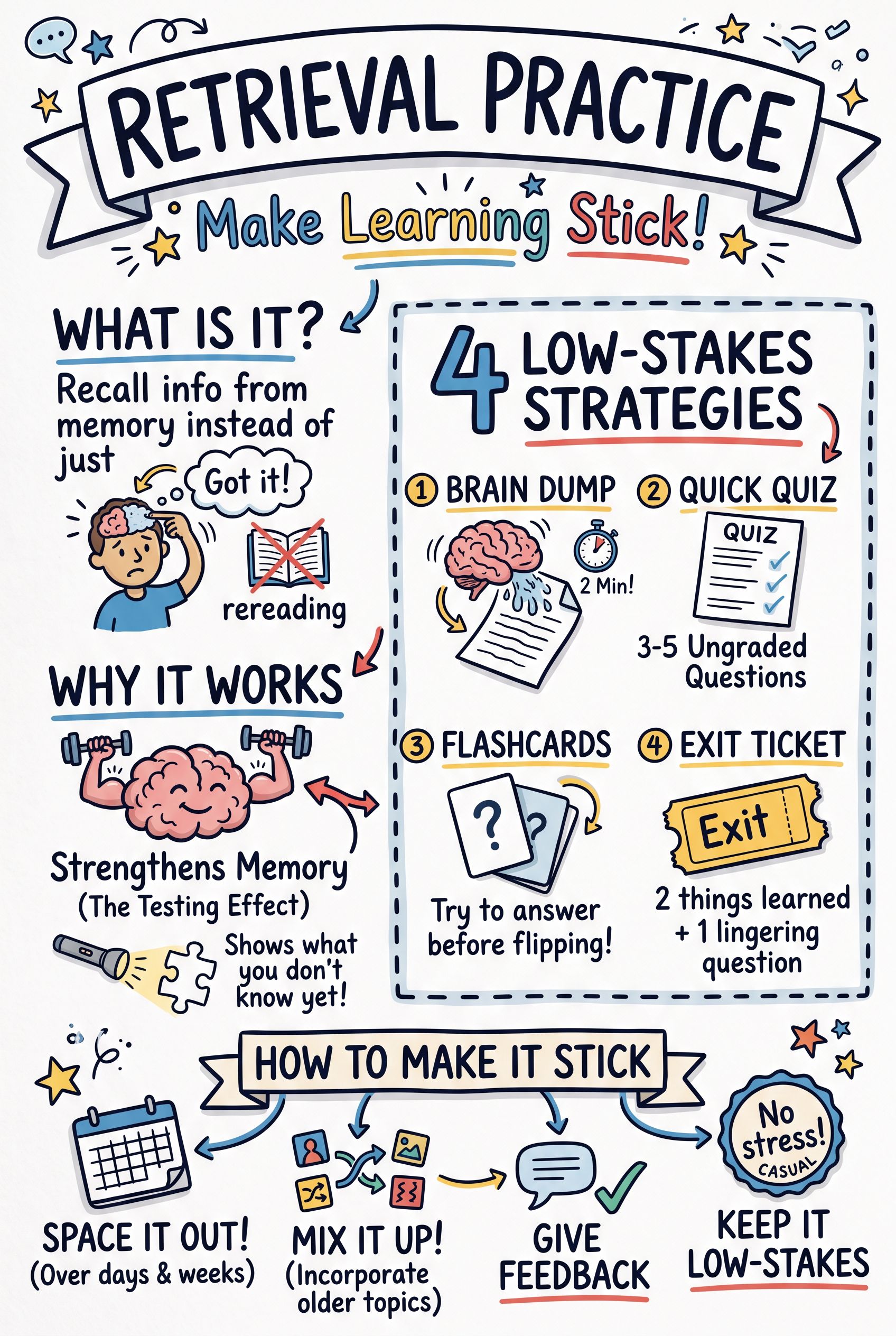
Retrieval practice means asking students to recall information from memory instead of rereading or reviewing their notes. Each time they pull an idea out of memory, it becomes easier to remember later.
What’s on this sketchnote
What it is
Recalling information from memory, rather than looking at it again.
Why it works
- Pulling information out of memory makes it easier to recall later. Researchers call this the testing effect.
- It shows students and teachers what has not been learned yet.
Four low-stakes strategies
- Brain dump: students write everything they remember about a topic for two minutes.
- Quick quiz: three to five ungraded questions at the start of class.
- Flashcards: students answer before they flip the card.
- Exit ticket: “Write two things you learned today and one question you still have.”
Make it stick
- Space it out: revisit topics days and weeks later, not only the next day.
- Mix it up: include questions from older units.
- Give feedback: go over the answers so mistakes are corrected.
- Keep it low-stakes, so it feels like practice, not a test.
Key vocabulary
- Testing effect: the finding that recalling information improves long-term memory more than restudying it.
- Spacing: spreading practice out over time.
- Interleaving: mixing questions from different topics in one practice session.
Use it in a workshop
- Open the session with a brain dump on what teachers already know about memory.
- Ask each teacher to plan one retrieval activity for next week and share it with a partner.
- End with an exit ticket, so participants experience the strategy themselves.
Further reading
The testing effect is described in Roediger and Karpicke’s 2006 study, Test-Enhanced Learning, published in Psychological Science.
Check for understanding
- Why is a quick ungraded quiz more useful for memory than rereading notes? Recalling the answer strengthens memory. Rereading only makes the material feel familiar.
- What does spacing mean in practice? Returning to a topic days or weeks later, instead of practicing it all at once.