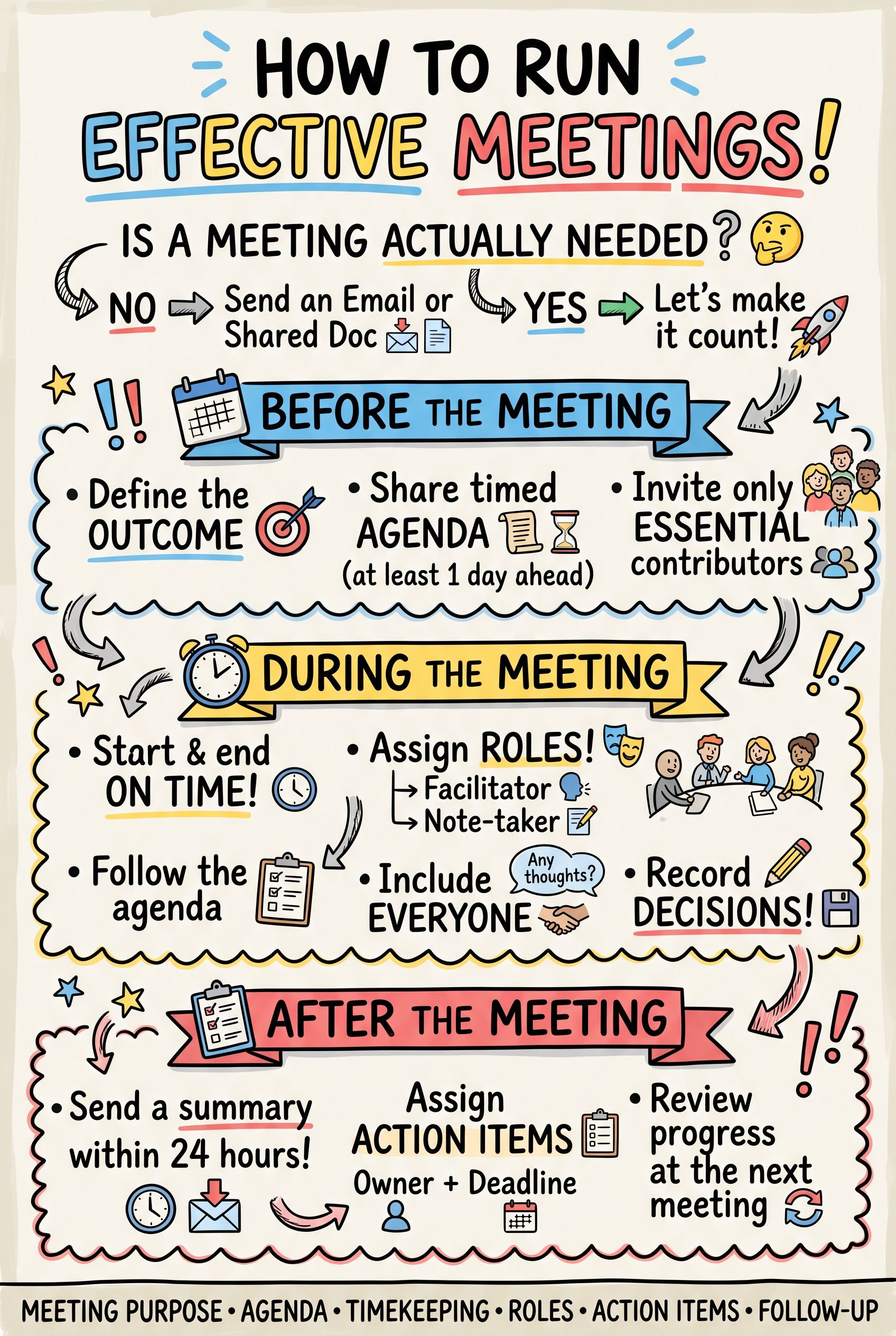
An effective meeting has a clear purpose, the right people, and a written record of what was decided. This sketchnote turns that into a checklist for before, during, and after the meeting.
What’s on this sketchnote
First ask: does this need a meeting?
Could an email or a shared document do the job instead?
Before
- Write down the purpose: what decision or outcome do we need?
- Share an agenda, with time for each item, at least a day ahead.
- Invite only the people who need to contribute or decide.
During
- Start and finish on time.
- Assign roles: facilitator, timekeeper, and note-taker.
- Follow the agenda and “park” off-topic ideas for later.
- Make sure everyone gets a chance to speak.
- Write decisions down as they are made.
After
- Send a short summary within 24 hours.
- List each action with an owner and a deadline.
- Start the next meeting by checking progress on those actions.
Key vocabulary
- Facilitator: the person who guides the discussion and keeps it on track.
- Parking lot: a list of off-topic ideas to come back to later.
- Action item: a task agreed in the meeting, with an owner and a deadline.
Use it at work
- Share the sketchnote with the agenda for your next staff or team meeting.
- Rotate the facilitator, timekeeper, and note-taker roles each week.
- Use the “After” column as a template for your meeting summary email.
Check for understanding
- What three things should every action item have? A clear task, an owner, and a deadline.
- When is a meeting not the best choice? When the goal is only to share information that an email or document could cover.